


 107 / 408

Chapter 1
- Projects - The most important ongoing projects
107
Statistical Year Book
الدليـــل الإحصــائــي الســـنوي
The development of Jamal Abdul Nasser road project
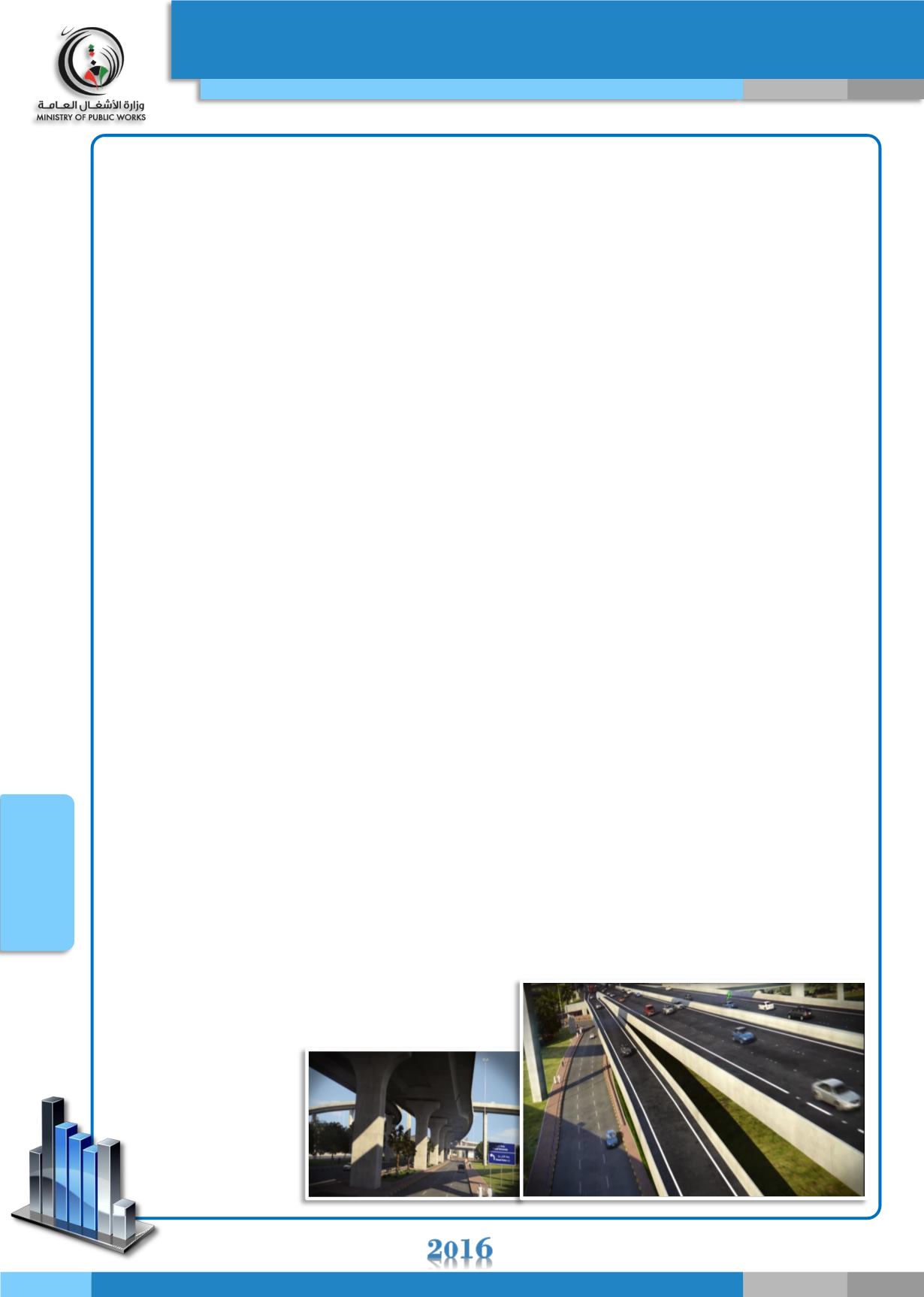
The Ministry of Public Works is implementing the development of Jamal Abdul Nasser road project, which includes the
conversion of the existing road to a multi-storey highway that characterized by the global highways standards, which in turn will
become one of the largest infrastructure projects at the international level in the region, where it aims to raise the absorptive
capacity of the traffic of the road and upgrade the level of security and traffic safety, which will reduce the ratios of accidents
and traffic congestion dramatically, and is considered one of the strategic projects undertaken by the ministry, that is
implemented in preparation for the future traffic’s requirements, and raise the level of services for the roads’ users.
The project is located in the western region of the city of Kuwait (Al Asima) where it runs from the Jahra Gate roundabout
(Sheraton roundabout) to the east of Ghirnata region north of Al-Asima. It serves as the infrastructure for many of the
government, educational and health entities, which are: the Kuwait University, the Public Authority for Applied Education &
Training, and major hospitals in the region that are located adjacent to the road in addition to Kuwaiti ports Foundation, which
will contribute to facilitating the movement of access and exit to and from those places mentioned above, and that is through
the separation of the different passing and local traffic paths.
Project phases:
Due to the nature of the area and its high rate of traffic flow, the project’s implementation has been divided into five phases,
which will be embarked in a synchronized matter in order to avoid traffic congest at peak times, and facilitate the movement of
entry and exit to and from all the areas, and the existing services on the sides of the road. The five phases are as follows:
Phase 1: From the First Ring Road to the east of Airport road, including the Second Ring road.
Phase 2: From the east of Girnata area to the east of the Hospitals road (Sabah Health area).
Phase 3: From the east of the Hospitals road to the west of Ghazali road, including the Hospitals road.
Phase 4: From the east of Ghazali road to the east of the Airport road, including the Airport road.
Phase 5: The intersection of Ghazali only.
Construction works, which are centered on several levels:
The upper level: It features 18.6 of overhead bridges (Precast pieces method), including 7.2 in the main Jamal Abdul Nasser
street, 1.4 km for the roads that are intersected with it, and 10 km of slopes. The upper level also features 3 intersections with
slopes (multi-storey) and 8 pedestrian bridges.
Ground level: It feature 2.1 km in the main Jamal Abdul Nasser street, 13.7 of service roads, 1.8 km of slopes, and 9 cycles.
Lower level: It includes a tunnel of approximately 716 meters in Jamal Abdul Nasser street from its intersection with the
Second Ring Road, in addition to the infrastructure services.
The project’s implementation and its detailed and complex works required the use of the latest technologies, including full
hyperbolic installation respectively by the modern hanging and mobile crane.
From the main elements that reflect the magnitude of the project is the construction of a large group of bridges and cliffs, which
reaches up to a total length of 22.666 km.
The Pre-cast square for manufacturing the bridges unites in Doha area with a total area of up to 130,000 Mitr².
Total number of pieces: 8600 pieces.
Production rate: 10 pieces a day.
Number of cranes: 15 mechanic crane.
The project also contains about one million cubic meters of reinforced concrete, including manufacturing and construction of
reinforced concrete elements bearing bridges and cliffs.
The total length of the pegs: 149,000 meters.
Total volume of bases: 140,000 m³.
Total columns size: 124,000 m³.